



Evicting a tenant is one of the more challenging situations a rental property owner can face. Whether the issue involves unpaid rent, lease violations, or serious misconduct, Arizona landlords must follow specific legal procedures to regain possession of their property.
Arizona has a relatively streamlined eviction process. Straightforward, uncontested cases can often be completed within a few weeks, although the timeline depends on the reason for eviction, proper notice, court proceedings, and enforcement.
Understanding the process helps landlords avoid costly mistakes, set realistic expectations, and protect their investment.
What Are the Steps in the Arizona Eviction Process?
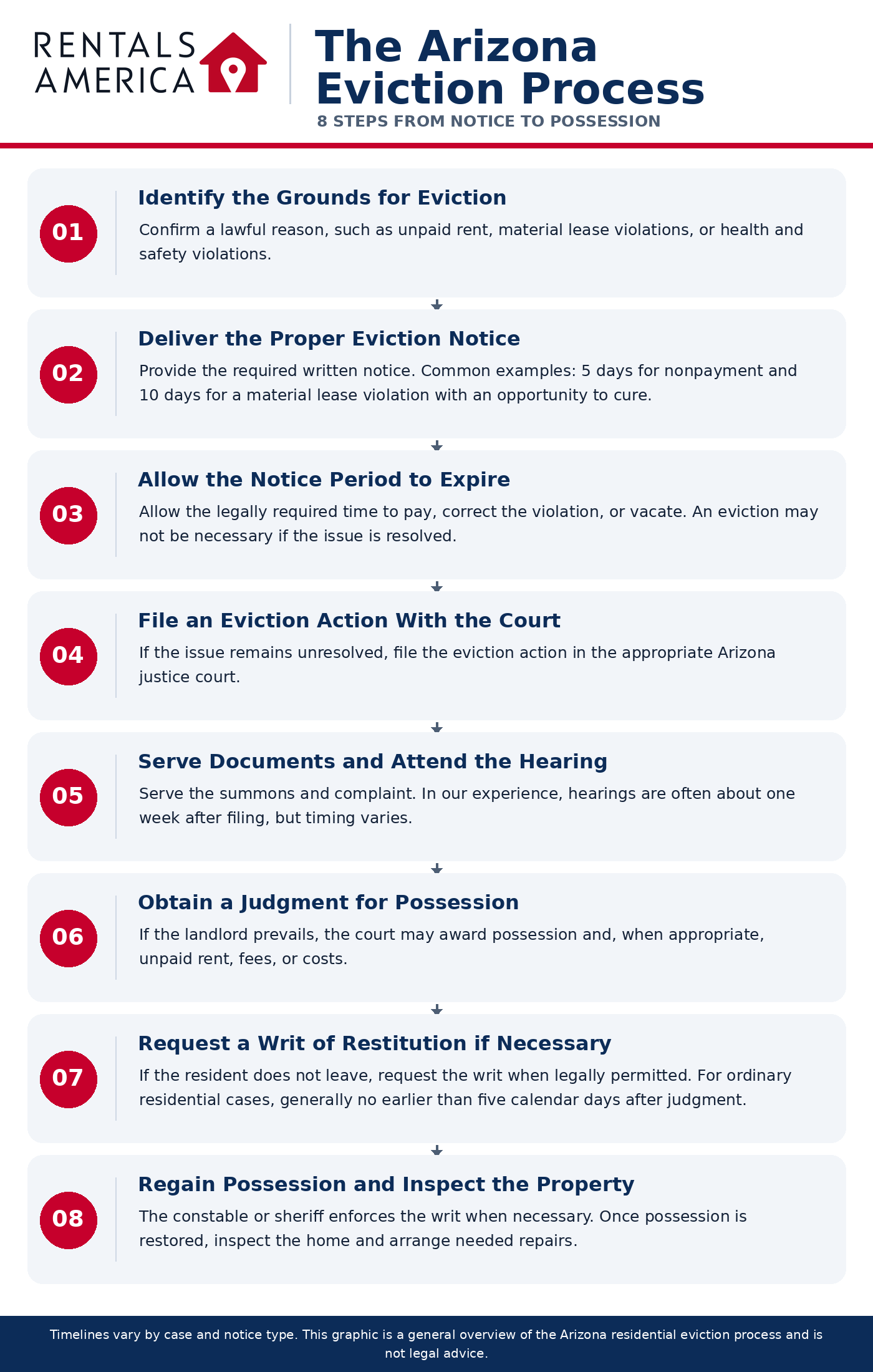
An Arizona residential eviction generally follows eight steps:
- Identify the legal grounds for eviction.
- Deliver the required written notice.
- Allow the applicable notice period to expire.
- File an eviction action with the court.
- Serve the court documents and attend the hearing.
- Obtain a judgment for possession.
- Request a writ of restitution if necessary.
- Regain possession and inspect the property.
Not every eviction requires all eight steps. A resident may resolve the issue or voluntarily surrender possession before the case reaches court.
Step 1: Identify the Grounds for Eviction
A landlord must have a legally recognized reason to terminate the tenancy or recover possession.
Common reasons include nonpayment of rent, material lease violations, health and safety violations, serious misconduct, and remaining in possession after a tenancy has lawfully ended.
In our experience at Rentals America managing thousands of rental homes, nonpayment of rent is the most common reason for eviction and generally the most straightforward to establish.
Other violations can be more challenging. Disputes involving unauthorized occupants, repeated disturbances, or property damage may require photographs, written communications, witnesses, or other supporting evidence.
The reason for eviction determines which notice is required and whether the resident has an opportunity to correct the problem.
Step 2: Deliver the Proper Eviction Notice
Arizona landlords generally must provide written notice before filing an eviction action. The applicable requirements are outlined in A.R.S. § 33-1368.
| Reason | General Notice Requirement |
|---|---|
| Nonpayment of rent | 5-day notice to pay |
| Material lease violation | 10-day notice with opportunity to cure |
| Material health or safety violation | 5-day notice with opportunity to cure |
| Material and irreparable breach | Immediate termination notice |
| Month-to-month termination | Generally 30 days’ notice, subject to statutory timing requirements |
Repeat violations and certain other circumstances may require different procedures. Month-to-month termination is governed separately under A.R.S. § 33-1375
How We Handle Eviction Notices
For the Arizona properties we manage, we prepare the required notices and send them by certified mail.
Under Arizona law, certified-mail notice is deemed received upon actual receipt or five days after mailing, whichever occurs first.
Consequently, a five-day nonpayment notice can effectively require approximately ten days from mailing before an eviction action may be filed if the notice is not received earlier.
We retain copies of notices and proof of mailing to document compliance with the applicable requirements.
Step 3: Allow the Notice Period to Expire
Depending on the violation, the resident may have an opportunity to correct the problem before an eviction is filed.
For nonpayment, the resident can generally prevent termination by paying the amount legally required within the applicable period. Certain lease violations can also be corrected within the notice period.
Can a Landlord Accept Partial Payments?
Sometimes a reasonable payment arrangement can help an otherwise reliable resident overcome a temporary hardship.
We occasionally consider weekly or biweekly payment arrangements when a resident has a legitimate hardship and a credible plan to get caught up. These arrangements allow rent to continue being collected throughout the month while providing limited flexibility.
However, payment arrangements should be used sparingly and should not become a recurring substitute for the lease’s payment requirements.
Under A.R.S. § 33-1371, accepting partial rent payments can affect a landlord's right to proceed with eviction. A written payment agreement should establish the terms, including when the remaining balance is due, and preserve the landlord's applicable rights. Because improperly handled payments can complicate an eviction, landlords should coordinate with legal counsel when necessary.
Step 4: File an Eviction Action With the Court
If the resident does not resolve the issue or surrender possession, the landlord may proceed with an eviction action.
Arizona residential evictions are generally filed in the appropriate justice court for the property's location.
For a typical nonpayment case, we provide our attorney with:
- A copy of the five-day notice.
- Proof of certified mailing.
- The resident’s rent ledger.
- The lease agreement and relevant supporting documents.
The attorney prepares and files the court documents.
Accurate records help support the case and reduce the risk of unnecessary delays.
Step 5: Serve Court Documents and Attend the Hearing
After filing, the resident must be served with the required court documents, including the summons and complaint.
In our experience, straightforward nonpayment cases often have a hearing scheduled approximately one week after filing, although actual timing varies.
At the hearing, the court determines whether the landlord has established the grounds for eviction and complied with legal requirements.
The court may enter judgment, dismiss the case, or require additional proceedings.
Nonpayment cases are generally more straightforward because the payment history and lease terms provide much of the necessary evidence. Other violations may require witnesses or additional documentation.
Step 6: Obtain a Judgment for Possession
If the landlord prevails, the court may enter a judgment awarding possession of the property. Depending on the circumstances, the judgment may also address unpaid rent, court costs, attorney fees, and other recoverable amounts.
However, winning an eviction case does not authorize the landlord to immediately change the locks or remove the resident.
For ordinary Arizona residential evictions, a writ of restitution generally cannot be issued until five calendar days after judgment. Qualifying material and irreparable breaches have different enforcement timelines.
Step 7: Request a Writ of Restitution
If the resident does not leave voluntarily, the landlord may request a writ of restitution once legally permitted.
This court order authorizes the constable or sheriff to restore possession to the landlord.
When a court-ordered lockout becomes necessary, we coordinate with the constable and locksmith to recover possession of the property.
Landlords should never attempt to force a resident out by independently changing locks, removing belongings, or shutting off utilities.
Step 8: Regain Possession and Inspect the Property
After possession has been lawfully recovered, the next priority is evaluating the property's condition and preparing it for another resident.
We perform a final inspection, identify necessary repairs, and coordinate the work needed to return the home to rent-ready condition.
If personal belongings remain, Arizona's applicable requirements for handling abandoned property must be followed.
The owner may also need to address outstanding balances, security deposit accounting, and potential collection efforts.
Regaining possession is an important milestone, but it does not necessarily mean the owner's financial losses have been recovered.
How Long Does an Eviction Take in Arizona?
A straightforward, uncontested nonpayment eviction can often be completed within a few weeks, but the actual timeline varies.
The process generally includes:
- Notice period: Five days for nonpayment, plus up to five additional days for certified-mail delivery.
- Court proceedings: A hearing is typically scheduled promptly after filing.
- Judgment: The court may enter judgment at the initial hearing or require additional proceedings.
- Possession: A writ of restitution generally becomes available five calendar days after an ordinary residential eviction judgment, with additional time potentially needed for enforcement.
Contested cases, improper notices, missing documentation, and scheduling delays can extend the process.
Landlords should avoid assuming that possession will be recovered by a specific date.
How Much Does an Eviction Cost in Arizona?
Eviction costs depend on the attorney, court fees, service requirements, and complexity of the case.
Based on our experience, legal and court-related eviction expenses are often around $600, although contested or complicated cases can cost considerably more.
The financial impact may extend beyond legal expenses and include unpaid rent, vacancy, property damage, and turnover costs.
Even when a landlord obtains a monetary judgment, collecting the outstanding balance is a separate process and is not guaranteed.
Our Eviction Protection Guarantee
We offer an Eviction Protection Guarantee that covers up to $5,000 in eligible eviction-related legal expenses when an eviction becomes necessary for a qualifying resident placed by Rentals America, subject to the guarantee’s terms.
This benefit helps reduce the owner’s direct legal expenses, although it does not eliminate losses from unpaid rent, property damage, or vacancy.
How Can Landlords Reduce the Risk of Eviction?
While no screening process can eliminate every risk, several practices can help landlords avoid unnecessary evictions.
Screen applicants carefully. A consistent review of credit, income, rental history, and other relevant qualifications helps identify potential concerns before signing a lease. Learn more about our resident screening process (https://phoenix.rentalsamerica.com/tenant-placement).
Use a clear lease agreement. Establish payment requirements, resident responsibilities, and property rules before move-in.
Address problems promptly. Allowing unpaid balances or lease violations to continue can increase financial exposure.
Maintain accurate documentation. Written communications, inspection reports, photographs, and payment records can become important evidence.
Consider reasonable solutions when appropriate. A carefully structured payment arrangement may prevent an unnecessary eviction when a resident experiences a temporary hardship.
The objective is to maintain successful tenancies whenever reasonably possible while taking appropriate action when residents fail to meet their obligations.
Frequently Asked Questions About Arizona Evictions
Can a landlord evict a tenant without going to court?
If a resident voluntarily leaves after receiving proper notice, a court eviction may not be necessary. However, when a resident refuses to surrender possession, the landlord generally must obtain a court judgment and follow the lawful enforcement process.
Can a tenant stop an eviction by paying overdue rent?
In a nonpayment case, Arizona law generally allows a resident to reinstate the rental agreement by paying the legally required amounts before judgment. Additional costs may apply once legal proceedings have begun.
Can a landlord change the locks after winning an eviction?
Not immediately. The landlord must wait until possession has been lawfully restored, including execution of a writ of restitution when necessary.
What happens if the tenant does not appear in court?
The court may enter a default judgment if the landlord has complied with the required procedures and established entitlement to relief. A judgment is not automatic simply because the resident fails to appear.
Does an eviction judgment guarantee collection of unpaid rent?
No. A monetary judgment establishes a legal obligation, but collection is a separate matter and depends on the circumstances.
Final Thoughts
Arizona provides landlords with a relatively efficient eviction process, but success depends on proper notices, accurate documentation, and compliance with court procedures.
In our experience, acting promptly and maintaining thorough records can help prevent unnecessary delays and financial losses.
The goal is not simply to remove a resident. It is to protect the investment, recover possession lawfully, and return the property to productive use as efficiently as possible.
For additional guidance on owning and managing rental property, explore our Phoenix Landlord Playbook (https://phoenix.rentalsamerica.com/owner-landlord-hub).
This article provides general educational information about Arizona residential evictions and is not legal advice. Requirements may vary depending on the circumstances, and landlords should consult qualified legal counsel when necessary.
.jpg)