

The Phoenix rental market remained largely unchanged in October 2026. According to Zillow’s Observed Rent Index (ZORI), the typical rent across the Phoenix metropolitan area was $1,717, virtually identical to September and 1.4% higher than a year earlier.
While rents have gradually recovered from their late-2025 lows, monthly growth has slowed considerably. For Phoenix landlords, the latest figures reinforce the importance of competitive pricing and minimizing vacancy rather than expecting substantial rent increases.
Phoenix Rental Market at a Glance
Typical Phoenix Metro Rent: $1,717
Month-over-Month Change: 0.0%
Year-over-Year Change: +1.4%
U.S. Typical Rent: $1,913
U.S. Year-over-Year Change: +2.9%
Source: Zillow Observed Rent Index (ZORI), October 2026.
Phoenix Rent Trends
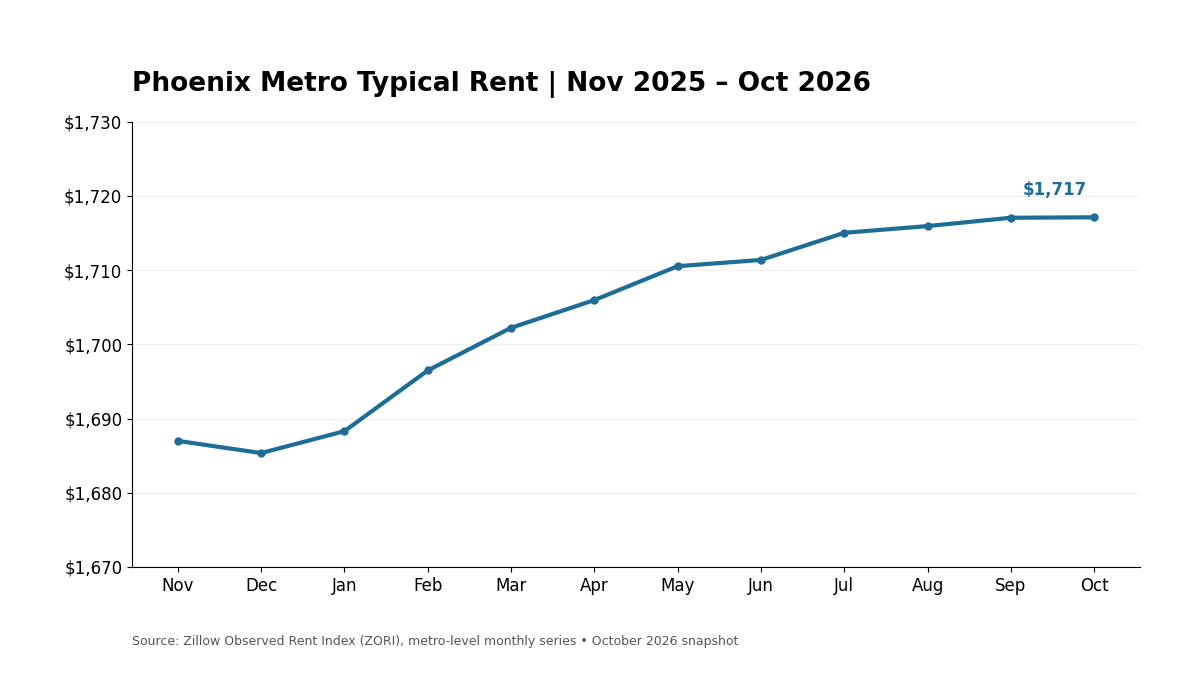
Phoenix Metro Typical Rent | Nov 2025 – Oct 2026
Phoenix rents have gradually increased since reaching approximately $1,685 in December 2025. By October 2026, the typical metro rent had climbed to $1,717, an increase of roughly $32 over that period.
Most of that recovery occurred during the first half of the year. Monthly increases became progressively smaller during the summer, and rents were essentially flat between September and October.
On an annual basis, Phoenix rents increased 1.4%, compared with 2.9% nationally. The gap illustrates that rent growth in Phoenix continues to lag the broader U.S. market.
The overall trend suggests a rental market that has stabilized following earlier softness, but has yet to demonstrate sustained, meaningful rent acceleration.
What Changed This Month?
The most notable development in October was how little rents changed.
Phoenix’s typical metro rent increased by less than one dollar from September, effectively remaining flat. Meanwhile, annual rent growth improved from approximately 1.1% in September to 1.4% in October, based on Zillow’s latest historical data.
That improvement doesn’t necessarily indicate stronger current demand. Annual comparisons are influenced by rent levels a year earlier, and the latest monthly figures show little upward movement.
September’s report highlighted a substantial increase in Zillow’s renter-demand index, even as rent growth remained modest. October’s pricing data continues to show limited rent appreciation, although it does not independently establish whether renter demand has increased or decreased.
For landlords, the distinction matters. Improving demand indicators can be encouraging, but asking rents, competing inventory, and actual leasing activity ultimately determine what an individual property can achieve.
What Does This Mean for Phoenix Landlords?
Our assessment remains largely unchanged: competitive pricing continues to be essential, particularly as we move into the slower holiday leasing season.
A stable metro rental market doesn’t mean every property will perform the same way. Homes in Scottsdale, Chandler, Gilbert, Mesa, Glendale, and other Valley communities can face very different levels of competition depending on location, condition, amenities, and available inventory.
At Rentals America, we evaluate more than recent comparable rents when recommending an asking price. Current competing listings, renter inquiries, showing activity, and applications help us determine whether a property is positioned appropriately.
When a vacant home isn’t attracting sufficient interest, we generally recommend reviewing the listing and pricing promptly rather than waiting indefinitely for the market to improve. Even relatively small adjustments can make a difference when prospective renters are comparing several similar properties.
Vacancy costs also deserve consideration. For example, losing one month of rent on a $2,000 property would offset 20 months of an additional $100 in monthly rent. Holding out for a higher asking price isn’t always the most profitable decision.
The goal is to establish a competitive rental rate that attracts qualified applicants while protecting the owner’s long-term rental income.
Related: How to Price Your Rental Property in Phoenix
Phoenix Rental Market Outlook
As Phoenix enters the final months of 2026, the rental market appears likely to remain relatively stable in the near term, although future rent movements are uncertain.
Seasonal leasing activity often slows during the holidays, which can make pricing and property presentation especially important for owners with vacant homes. However, seasonal patterns vary, and individual properties may experience stronger or weaker demand.
The October figures don’t provide evidence of a significant new upward or downward trend. We’ll continue monitoring whether rents maintain their current levels, resume modest growth, or soften during the winter months.
For a broader look at the region’s population growth, housing supply, construction activity, and long-term rental trends, visit our Phoenix Rental Market Report.
Phoenix Rental Market FAQ
What is the average rent in Phoenix in October 2026?
According to Zillow’s Observed Rent Index, the typical rent across the Phoenix metropolitan area was $1,717 in October 2026. This is a metro-wide index, not the average rent for every type of rental property or neighborhood.
Are Phoenix rents increasing or decreasing?
Phoenix rents were essentially unchanged in October 2026, with a 0.0% month-over-month change. Compared with October 2025, rents were 1.4% higher, indicating modest annual growth despite recent monthly stability.
Is now a good time to increase rent on a Phoenix rental property?
That depends on the individual property and its current rental rate. With metro rents increasing just 1.4% annually, landlords should evaluate comparable properties, competing inventory, resident retention, and potential vacancy costs before deciding whether an increase is appropriate.
About the Data
Rental figures are based on Zillow’s Observed Rent Index (ZORI), using the monthly metropolitan-area series for October 2026. ZORI measures typical asking rents across the rental market and may be revised as Zillow updates its data. Metro-wide trends provide useful context, but individual homes and neighborhoods may perform differently.