

Phoenix rents remained relatively stable in September, even as Zillow reported a significant increase in rental demand across the metro.
According to the Zillow Observed Rent Index (ZORI), the typical rent across the Phoenix metro was $1,720 in September 2026, up 0.1% from the previous month and 1.0% from a year earlier.
Phoenix Rental Market at a Glance
Typical Phoenix Metro Rent: $1,720
Month-over-Month Change: +0.1%
Year-over-Year Change: +1.0%
U.S. Typical Rent: $1,932
U.S. Year-over-Year Change: +2.7%
Source: Zillow Observed Rent Index (ZORI), September 2026.
Phoenix Rent Trends
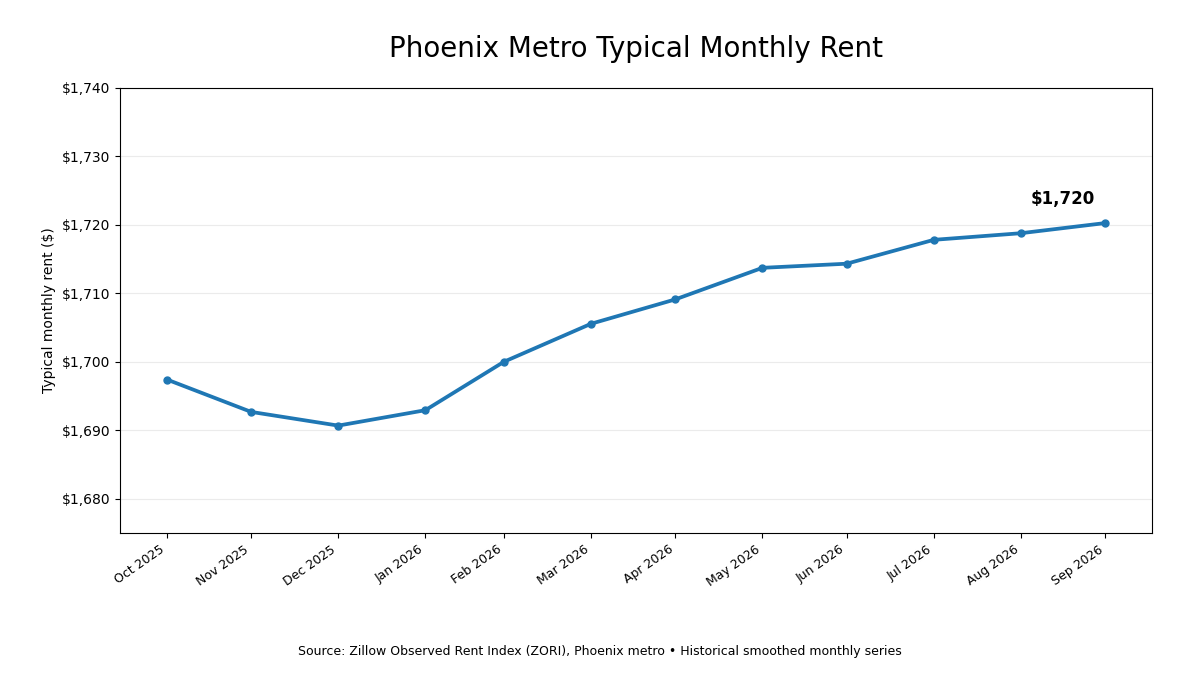
Phoenix rents have remained relatively stable, with only modest changes in typical rents over recent months. The updated Zillow historical series shows rents generally increasing since December 2025, although the gains have been small.
Year-over-year rent growth reached 1.0% in September, compared with 0.7% in August. Phoenix continues to experience slower rent growth than the national market.
The longer-term trend suggests a market that is stabilizing rather than experiencing a significant increase or decrease in rents.
What Changed This Month?
One of the more interesting developments in September was an increase in rental demand.
Zillow reported that its Phoenix metro renter-demand index increased 43.0% year over year, among the largest increases of the major metropolitan areas it tracks.
Despite that increase, typical rents rose just 1.0% over the same period. Zillow noted that new construction has helped rental supply keep pace with demand in Phoenix.
This distinction is important. Stronger renter demand does not necessarily translate into rapidly increasing rents when renters continue to have competing properties available.
What Does This Mean for Phoenix Landlords?
Our overall assessment remains largely unchanged.
Competitive pricing continues to be one of the most important factors affecting leasing performance. Even with stronger rental demand, owners should evaluate their property’s asking rent against comparable available homes rather than assuming the broader market will support a substantial increase.
Property condition, location, amenities and competing inventory all influence how quickly a rental attracts qualified applicants.
When a property isn’t generating the expected activity, we generally favor responding to the market rather than allowing an extended vacancy while waiting for a higher rent.
Related: How to Prepare Your Home for Rent
Phoenix Rental Market Outlook
The Phoenix rental market continues to show signs of stability, with modest rent growth and improving demand.
The increase in renter demand is encouraging, but it is too early to conclude that the market is entering a period of stronger rent appreciation. Rental supply and competition will remain important factors to watch.
We’ll continue monitoring whether stronger demand translates into faster leasing activity, fewer concessions or more sustained rent growth.
Individual results can vary considerably by property type, condition and location. Rental properties in Phoenix, Scottsdale, Chandler, Gilbert, Mesa, Glendale and other parts of the metro may perform differently from the metropolitan average.
For a deeper look at rental supply, demand, long-term trends and the factors affecting rental-property performance, visit our Phoenix Rental Market Report.
Phoenix Rental Market FAQ
What is the typical rent in the Phoenix metro?
According to Zillow’s Observed Rent Index, the typical Phoenix metro rent was $1,720 in September 2026.
Are Phoenix rents increasing?
Yes, but modestly. Zillow reported Phoenix metro rents up 1.0% year over year and 0.1% month over month in September 2026.
Is rental demand increasing in Phoenix?
Zillow reported a 43.0% year-over-year increase in its Phoenix metro renter-demand index in September. However, typical rents increased only 1.0% over the same period, suggesting that increased demand has not yet translated into substantial rent growth.
About the Data
Market data is based on the Zillow Observed Rent Index (ZORI) for the Phoenix metropolitan area. Rental-demand figures are based on Zillow’s Observed Renter Demand Index (ZORDI). Zillow periodically revises historical data. Metro-wide trends provide useful context, but individual properties and submarkets may perform differently.