
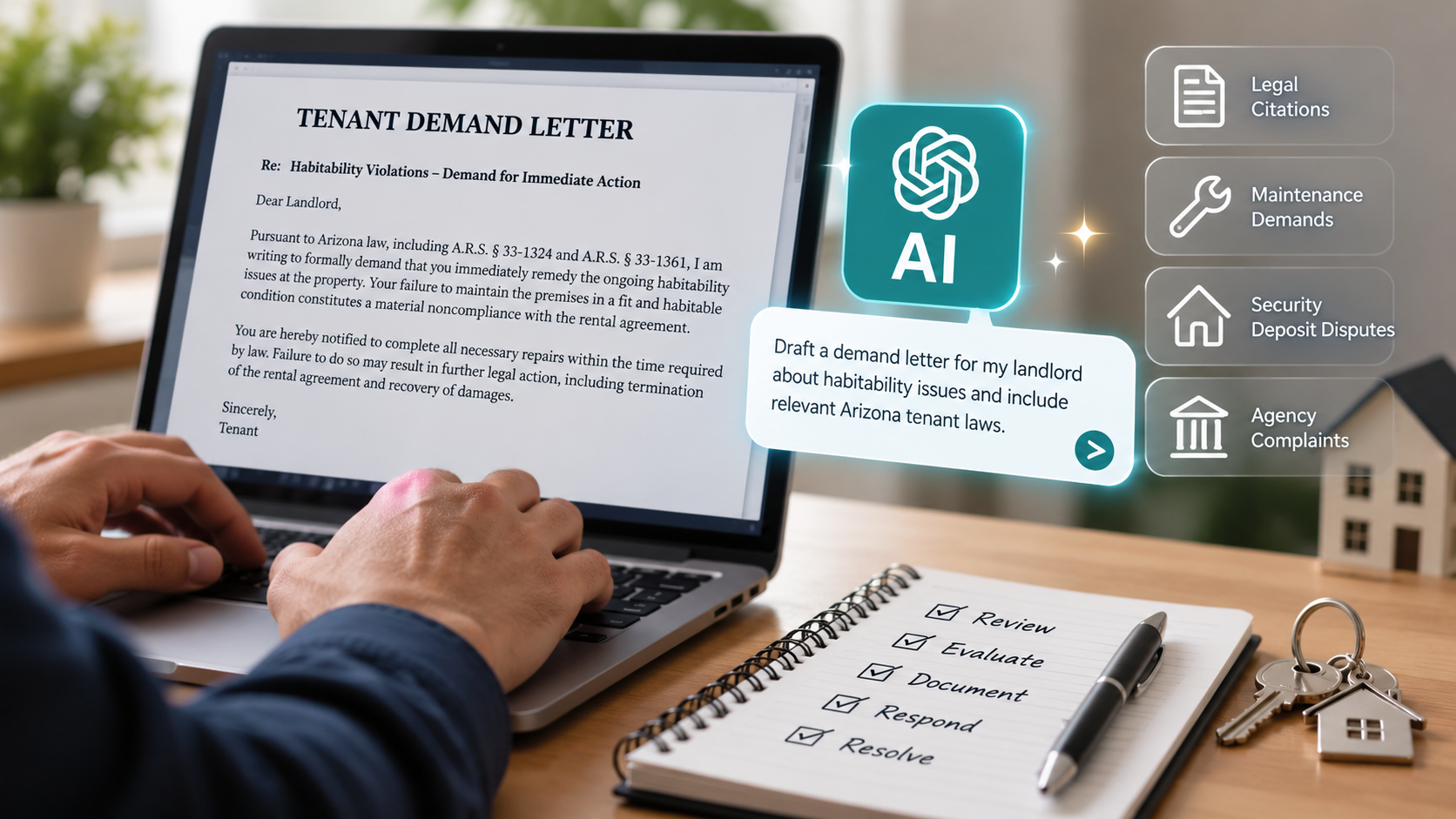
Artificial intelligence is changing how tenants communicate with landlords, and property owners may be surprised by just how quickly the landscape is shifting.
Tools like ChatGPT make it possible to generate formal demand letters, challenge security deposit deductions, and prepare complaints citing legal statutes in a matter of minutes.
At Rentals America, we’re seeing this firsthand. Tenant complaints are becoming more frequent, more detailed, and increasingly appear to be drafted with the assistance of AI.
According to Zillow’s October 2026 Consumer Housing Trends Report, 78% of recent renters use AI at least occasionally. Among recent renters who used AI during their rental journey, 45% used it for personalized lease questions. These figures do not measure tenant disputes, but illustrate the growing use of AI for housing-related questions.
For landlords, this creates both opportunities and challenges.
The Rise of AI-Assisted Tenant Complaints
Not long ago, preparing a formal legal demand often required substantial research or assistance from an attorney. Today, a resident can describe a disagreement to an AI tool and receive a polished letter filled with legal terminology, statutory references, and demands for action.
We’re seeing more of these communications across the Phoenix rental market, particularly involving security deposits and maintenance concerns. In some cases, residents appear more willing to escalate disagreements to regulatory agencies rather than first working through the normal process with their property manager.
This doesn’t necessarily mean the complaints lack merit. Many raise legitimate questions or concerns. However, the ease of generating persuasive legal arguments can make a resident’s position appear more definitive than the facts or applicable law support. For landlords, the challenge is separating the substance of the complaint from the sophistication of its presentation.
Security Deposit Disputes Are a Common Flashpoint
Security deposits have always been a frequent source of landlord-tenant disagreements. AI is making it easier for residents to prepare detailed objections to deductions for cleaning, repairs, and property damage.
In security deposit disputes, the practical question is not whether a resident can produce a convincing objection, but whether the deduction is supported by the condition documented at move-in and move-out, the work performed, and the applicable rules. Our team is seeing longer challenges that require us to revisit that evidence carefully, even when the original accounting was prepared through our normal process.
These challenges can include references to Arizona landlord-tenant statutes, demands for supporting documentation, and arguments about whether a particular charge is reasonable. Some objections are entirely appropriate. Landlords should distinguish ordinary wear and tear from tenant-caused damage and support deductions with reliable evidence.
But AI-generated arguments don’t always account for the property’s documented condition, the history of the tenancy, or the actual circumstances surrounding a charge. At Rentals America, responding to increasingly lengthy objections can require considerable time, even when the underlying charges are supported by photographs, inspection records, and vendor invoices.
This reinforces a principle we’ve emphasized for years: good documentation is essential. For a closer look, see our article on Normal Wear and Tear vs. Tenant Damage.
Maintenance Complaints: Understanding the Process Matters
Maintenance is another area where we’re encountering more AI-assisted demand letters. A resident reporting an air-conditioning problem, plumbing issue, or other repair concern may submit a lengthy letter referencing habitability requirements, legal deadlines, and potential remedies.
Arizona landlords have important maintenance obligations under the Arizona Residential Landlord and Tenant Act. However, the applicable requirements depend on the nature of the problem and the circumstances. Some AI-generated demands overlook these distinctions. They may suggest that a repair must be completed immediately when the law provides a particular notice-and-remedy process or otherwise requires action within a reasonable period. Urgent health and safety issues may require a different response from routine repairs.
We’ve encountered situations where residents appear to rely on incomplete legal information, sometimes escalating matters before the normal repair process has had an opportunity to work. The appropriate response is to identify the underlying concern, evaluate its urgency, communicate with the resident, and take the necessary action.
When AI Gets the Law Wrong
One of the challenges with AI-generated legal information is that it can sound convincing even when it’s incorrect. Our team has encountered correspondence referencing laws that don’t apply to residential rental properties or overlooking important procedural requirements.
AI may also misinterpret lease provisions, confuse laws from different jurisdictions, or present a legal conclusion without considering relevant facts. A resident relying on inaccurate information may believe they’re entitled to remedies that aren’t available under the circumstances. Conversely, a landlord unfamiliar with the law may feel pressured to accept demands simply because they’re presented in authoritative language.
A professionally written demand letter is not necessarily a legally valid claim. But landlords shouldn’t assume an AI-generated complaint is incorrect, either. The underlying concern may be legitimate even when the legal reasoning is flawed. The key is to evaluate the facts rather than react to the presentation.
Five Ways Landlords Can Protect Themselves
Start by separating the legal language from the underlying request. Identify what the resident wants, verify the relevant facts and requirements, and respond to the actual issue. A lengthy AI-assisted argument should not distract from legitimate concerns or established procedures.
1. Don’t be intimidated by formal demands. A lengthy letter filled with legal terminology may look alarming, but its appearance doesn’t determine its validity. Identify the actual issue and evaluate it objectively.
2. Maintain thorough documentation. Keep photographs, inspection reports, maintenance records, vendor invoices, and communications.
3. Follow established procedures. Whether handling a maintenance request or preparing a security deposit accounting, follow the lease and applicable law.
4. Respond promptly and professionally. Address legitimate concerns and explain the relevant facts without getting drawn into unnecessary arguments.
5. Recognize when legal guidance is appropriate. Formal statutory notices, agency complaints, threatened litigation, and complex disputes may warrant legal review.
Why Experience Matters More Than Ever
AI is helping residents research their rights and advocate for themselves. In many respects, that’s a positive development. But access to information doesn’t always translate into an accurate understanding of the law or the circumstances of a particular dispute.
For individual landlords, responding to increasingly formal complaints can be stressful and time-consuming. At Rentals America, our experience managing residential rental properties throughout the Phoenix area has reinforced the importance of consistent procedures, detailed documentation, and measured communication.
We’re spending more time addressing AI-assisted correspondence, but our approach remains the same: understand the concern, evaluate the facts, follow the law, and work toward an appropriate resolution. Our Phoenix Property Management Guide explains how professional management brings together resident relations, maintenance coordination, inspections, and compliance.
The Bottom Line
AI is changing how tenants challenge landlords, and its influence on rental disputes is likely to continue growing. Property owners should be prepared for more sophisticated demand letters, detailed objections, and residents relying on AI-generated legal information.
But there’s no reason to be intimidated. The language may be changing, but the fundamentals haven’t. Good documentation, legal compliance, timely responses, and professional communication remain the foundation of effective property management.
When faced with an intimidating demand letter, focus less on how it was written and more on what actually needs to be addressed.